
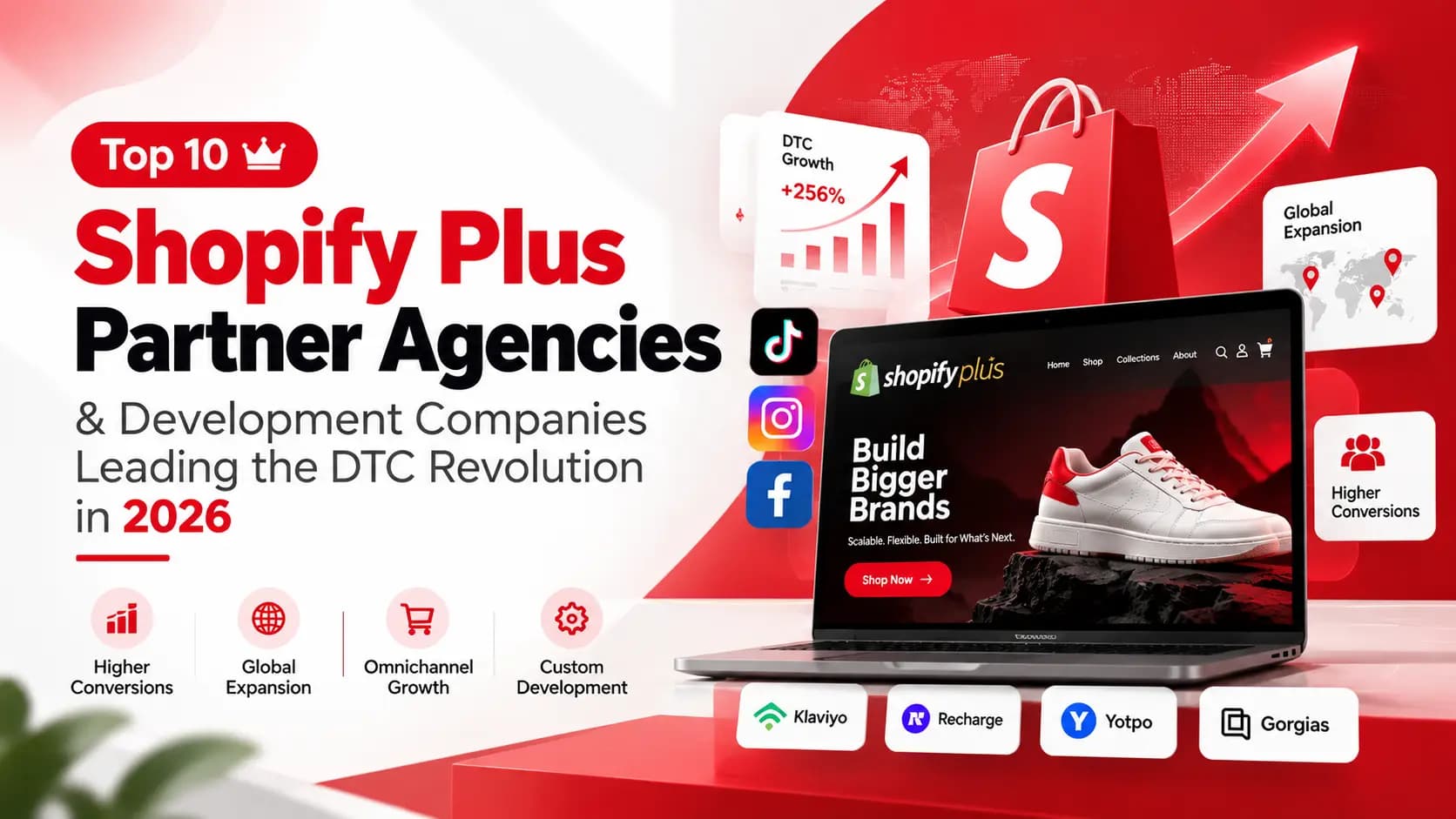
The direct-to-consumer (DTC) business model allows brands to sell directly to customers through their own ecommerce stores, social channels, and digital marketplaces. In 2026, Shopify Plus remains an option for growing brands that need advanced commerce features, custom integrations, and support for higher transaction volumes.
Choosing from the top Shopify Plus agencies requires more than comparing design portfolios. Brands need development partners that understand ecommerce operations, customer acquisition, conversion rate optimization (CRO), search engine optimization (SEO), and customer retention.
This guide covers 10 Shopify Plus development companies and ecommerce agencies to consider in 2026. It explains their service focus, the benefits of working with a specialist, and the factors DTC brands should evaluate before hiring an agency.
The Explosive Growth of DTC & Shopify Plus in 2026
Direct-to-consumer ecommerce gives brands greater control over customer relationships, product presentation, pricing, and first-party customer data. Businesses can build their own marketing channels, test new offers, and collect customer feedback without depending entirely on third-party retailers.
Shopify Plus supports these requirements through enterprise-oriented commerce features, automation, integrations, and international selling capabilities.
Several trends are shaping DTC ecommerce in 2026:
- Social commerce: TikTok, Instagram, and Facebook Shops help brands introduce products to customers and connect social discovery with online purchasing.
- Personalized shopping: Product recommendations, relevant offers, and customer-specific messaging help brands create more useful shopping experiences.
- International expansion: Shopify Markets supports international selling through market-specific configurations, currencies, and localized shopping experiences.
- Subscription commerce: Integration with subscription platforms such as Recharge helps eligible businesses manage recurring orders and customer subscriptions.
- Omnichannel retail: Shopify POS connects supported in-person sales workflows with Shopify commerce operations.
- AI integration: Ecommerce teams are using AI tools for customer support, product discovery, content workflows, and analysis, subject to the quality of their data and implementation.
These developments increase the need for reliable ecommerce infrastructure. A growing brand may need custom storefront development, improved checkout experiences, ERP and CRM integrations, technical SEO, and ongoing conversion testing.
Shopify Plus provides the underlying platform, while the right development agency helps implement the features that fit the business.
Why a Shopify Plus Expert Agency Is Essential for DTC Success
A Shopify Plus development agency helps businesses plan, build, integrate, and improve ecommerce stores. Specialist agencies can be particularly useful when a brand needs capabilities beyond a standard theme installation.
Here are six areas where an experienced Shopify Plus partner can contribute.
1. Custom Shopify Plus Development
Developers can customize Shopify themes using Liquid, HTML, CSS, JavaScript, and supported platform APIs. Custom development can improve product pages, navigation, collection filters, account experiences, and other storefront features.
2. Conversion Rate Optimization
Conversion rate optimization focuses on helping more qualified visitors complete valuable actions. Agencies can review analytics, conduct usability research, examine heat maps, and run A/B tests to identify problems with product discovery, cart usability, or checkout flows.
3. Store Migration and Replatforming
Brands moving from WooCommerce, Magento, BigCommerce, or Salesforce Commerce Cloud need a structured migration plan. This includes product data, customer records, order history, URL mapping, redirects, analytics, and integrations.
A migration agency should plan for search visibility and operational continuity before launch.
4. Enterprise System Integration
Shopify Plus stores may need connections with enterprise resource planning (ERP) systems, customer relationship management (CRM) platforms, warehouse software, payment providers, and customer service tools. Agencies can help design and test these integrations.
5. International Expansion
Brands selling across North America, the United Kingdom, Europe, and other markets may need localized content, currency configuration, tax workflows, regional pricing, and international SEO. Shopify Markets and appropriate third-party integrations can support these requirements.
6. Ongoing Optimization and Retention
Launching a store is only one part of ecommerce development. Continued work may include technical maintenance, performance monitoring, email and SMS marketing, customer service improvements, and repeat-purchase campaigns using platforms such as Klaviyo and Yotpo.
The right agency connects technical decisions with measurable business objectives rather than treating website development as an isolated project.
Agency Selection Guide: What Makes a True Shopify Plus Leader?
A strong Shopify Plus agency combines technical skills, ecommerce experience, clear project management, and an understanding of commercial goals.
Before choosing a development company, evaluate these criteria:
- Relevant experience: Look for projects involving businesses with similar products, order volumes, integrations, and operational needs.
- Platform expertise: Confirm experience with Shopify Plus features, custom theme development, APIs, and checkout requirements.
- Case studies: Review documented projects and ask which results can be attributed to the agency’s work.
- Technical SEO: Check whether the agency understands redirects, canonical tags, structured data, internal linking, crawlability, and indexation.
- Conversion testing: Ask how the team identifies user experience problems and measures improvements.
- Integration experience: Confirm that the agency can work with your existing ERP, CRM, inventory, fulfillment, and marketing systems.
- Project communication: Establish who manages the project, how often progress is reported, and how scope changes are handled.
- Post-launch support: Review maintenance plans, response times, development retainers, and ownership of code and digital assets.
Shopify Partner Program status can help establish a provider’s relationship with Shopify, but it should not replace an evaluation of relevant experience, delivery quality, and client references.
What Defines the Leading Shopify Plus Agencies in 2026?
The leading Shopify Plus development companies are not necessarily the largest agencies. Their suitability depends on the complexity of the project and the business outcomes the client needs.
For this guide, the selection focuses on agencies with identifiable ecommerce, Shopify development, digital experience, or integration services. The list is an editorial shortlist, not an independently verified ranking of agency performance.
A useful comparison considers four areas.
Technical capability: Can the team deliver custom development, migration, integrations, and performance improvements?
Commercial understanding: Does the agency understand customer acquisition, product merchandising, conversion, and retention?
Operational fit: Can the team support the company’s project size, internal resources, time zone, and launch schedule?
Long-term value: Does the agency provide documentation, reliable support, transparent communication, and a practical roadmap for future development?
Brands should verify current Shopify Partner Directory listings, relevant certifications, case studies, and references before signing a contract. Partner tiers and service offerings can change.
Introducing the Top 10 Shopify Plus Partners Shaping DTC in 2026
The following companies offer different approaches to ecommerce development and digital growth. Their order does not represent a verified performance ranking, and businesses should confirm each agency’s current Shopify Plus capabilities before engaging.
1. The Active Solutions
The Active Solutions works with direct-to-consumer brands that need support with Shopify development and ecommerce growth. Its service approach brings store development and optimization together with marketing activities that help businesses attract visitors and convert them into customers.
For brands operating in the United States, the United Kingdom, and other markets, the right combination of storefront development, acquisition, and retention can reduce the need to coordinate multiple disconnected providers.
Potential areas of collaboration include:
- Shopify development: Store setup, theme customization, storefront improvements, and ecommerce functionality.
- Conversion optimization: Reviewing customer journeys, product pages, navigation, and checkout usability.
- Paid marketing: Coordinating advertising campaigns with landing pages, offers, and product merchandising.
- SEO: Improving site architecture, technical accessibility, product and collection pages, and organic search visibility.
- Retention marketing: Supporting customer communication, repeat-purchase campaigns, and lifecycle marketing.
- Performance measurement: Connecting store analytics with business goals to identify areas for improvement.
For a DTC business, these services work best when they follow a shared growth plan. For example, an advertising campaign should direct visitors to a relevant landing page, while analytics should show whether those visitors purchase and return.
Brands considering The Active Solutions should review its current portfolio, confirm the precise scope of services available, and request examples relevant to their industry and growth stage.
2. Barrel
Barrel is a digital agency known for brand strategy, ecommerce experiences, and creative work. Its approach is relevant to businesses that need a stronger connection between brand identity, product presentation, and online shopping.
DTC companies often compete in crowded markets where product quality alone does not determine customer choice. Clear messaging, consistent visual design, and an easy purchasing process can influence how customers evaluate a brand.
When assessing Barrel, businesses should examine its current ecommerce portfolio, Shopify Plus experience, and approach to ongoing optimization. Ask how the agency connects creative decisions with usability, analytics, and commercial goals.
Barrel may be worth considering for brands that place a high priority on digital brand experience and ecommerce design.
3. Lounge Lizard
Lounge Lizard provides digital design, website development, branding, and marketing services. Businesses evaluating the agency can explore whether its current capabilities align with their Shopify development and ecommerce requirements.
For DTC brands, the connection between visual identity and shopping usability matters. Product pages need clear descriptions, useful imagery, accessible navigation, and a consistent presentation across desktop and mobile devices.
An ecommerce project may also require analytics, marketing integrations, and improvements to landing pages used by paid advertising campaigns.
Before engaging Lounge Lizard for a Shopify Plus project, confirm the team’s current platform specialization, relevant case studies, project process, and availability of post-launch support.
4. Endertech
Endertech is a technology-focused development company that businesses can evaluate for custom ecommerce development and integrations.
Complex stores may need functionality that extends beyond standard theme settings. Examples include custom applications, external APIs, inventory connections, and workflows linking ecommerce operations with other business systems.
For Shopify Plus projects, the key question is whether the assigned team has relevant experience with Shopify’s current APIs, app development requirements, and integration architecture.
Businesses with complex technical requirements should request a proposed architecture, a clear project scope, and a plan for testing and maintaining integrations after launch.
5. MTN Haus
MTN Haus is an agency to consider when evaluating ecommerce development and digital experience services. Its current service offering and Shopify Plus specialization should be confirmed directly before making a hiring decision.
DTC brands with multiple sales channels need consistent product information, inventory visibility, customer communication, and order workflows. Development partners may help connect these requirements with the storefront and the company’s operational systems.
A useful evaluation should cover custom development, mobile shopping experiences, integration capabilities, project management, and ongoing technical support.
Brands expanding into new markets should ask how the agency handles localization, regional storefront requirements, and coordination with existing business systems.
6. Propeller
Propeller is a digital agency associated with digital experiences and marketing services. It may be relevant to brands looking for a combination of website development, creative work, and digital marketing support.
Ecommerce growth depends on more than attracting traffic. Businesses need relevant landing pages, useful product information, a straightforward checkout process, and consistent measurement of customer behavior.
When assessing Propeller for Shopify Plus development, ask about its current Shopify portfolio, technical implementation capabilities, and the services included after launch.
Brands that need both creative and marketing support should clarify how the agency coordinates those activities with ecommerce development and performance reporting.
7. Ambaum
Ambaum is an ecommerce development company that businesses can evaluate for Shopify development, integrations, and technical consulting.
A growing store may need help moving from an older ecommerce platform, improving existing features, or connecting Shopify with external systems. These projects require careful planning because product data, customer records, URLs, and order workflows must remain consistent.
For a Shopify Plus migration, ask the agency to explain its approach to data validation, URL redirects, analytics continuity, integration testing, and launch monitoring.
A clear migration plan helps reduce operational disruption and protects important organic search landing pages.
8. Shero Commerce
Shero Commerce is an ecommerce agency to consider for businesses evaluating platform development, optimization, and digital commerce services.
A store migration or redesign creates opportunities to improve navigation, product discovery, mobile usability, and technical SEO. However, these improvements need to be supported by a clear understanding of existing performance and customer behavior.
Brands evaluating Shero Commerce should request examples of comparable projects and clarify the agency’s current capabilities across Shopify Plus development, migration planning, SEO, and conversion optimization.
Businesses should also ask how the agency measures results after launch and prioritizes future improvements.
9. Uncap
Uncap is included as an option for businesses researching ecommerce development and optimization partners. Its current Shopify Plus service scope should be verified before it is shortlisted for a specific project.
Conversion optimization projects typically begin by identifying friction in the customer journey. This may include unclear product information, difficult navigation, confusing shipping details, or unexpected checkout costs.
An agency working on these problems should establish baseline metrics, identify the main barriers to conversion, and test changes against defined objectives.
Brands should confirm the provider’s technical expertise, testing methodology, case studies, and ongoing support arrangements before proceeding.
10. Trellis
Trellis provides ecommerce and digital marketing services and is an option for businesses researching partners that combine commerce technology with broader digital growth activities.
Businesses with established operations may need to coordinate ecommerce platforms, marketing channels, product data, and backend systems. A suitable agency should understand how these components affect the customer experience and internal workflows.
For a Shopify Plus project, review the agency’s current platform experience, integration capabilities, analytics approach, and ability to support ongoing development.
Brands should also confirm project ownership, documentation standards, implementation timelines, and the availability of technical support after launch.
Critical SEO Best Practices for Shopify Plus in 2026
Shopify Plus SEO requires a combination of technical accessibility, useful content, effective site architecture, and a good shopping experience. A technically advanced store can still struggle in organic search when important pages are difficult to discover or product information is incomplete.
The following practices help establish a sound SEO foundation.
1. Build a Clear Site Architecture
Organize products into logical collections and categories. Use descriptive navigation labels and internal links so customers and search engines can discover important pages without unnecessary clicks.
2. Optimize Product and Collection Pages
Write distinct title tags, meta descriptions, headings, and product descriptions. Explain product features, materials, dimensions, compatibility, and other details customers need to make purchasing decisions.
3. Protect SEO During Migrations
Create a URL mapping document before migrating from WooCommerce, Magento, BigCommerce, or another platform. Redirect retired URLs to their most relevant equivalents, update internal links, and check canonical tags after launch.
4. Implement Structured Data
Use valid product structured data where appropriate to help search engines interpret information such as price, availability, and product details. Review the output for errors and keep the markup consistent with visible page content.
5. Improve Mobile Performance
Test Core Web Vitals, image loading, JavaScript execution, and theme performance. Remove unnecessary scripts and apps that slow down the shopping experience.
6. Strengthen Internal Linking
Connect related products, collections, buying guides, and educational articles. Internal links help customers find relevant products and support the discovery of important pages.
7. Plan International SEO Carefully
Use the correct market configuration, localized content, and appropriate international targeting signals. Review canonical and hreflang implementation where relevant to avoid sending conflicting signals to search engines.
8. Publish Useful Supporting Content
Create buying guides, product comparisons, maintenance advice, and answers to genuine customer questions. Content should help shoppers make decisions rather than exist solely to target keywords.
9. Monitor Indexing and Search Performance
Use Google Search Console to review indexing, sitemap processing, search queries, clicks, and impressions. Investigate duplicate URLs, unexpected noindex directives, redirect problems, and important pages that remain unindexed.
10. Measure Commercial Outcomes
Track organic revenue, qualified traffic, product-page engagement, conversion rates, and other relevant metrics. SEO performance should be evaluated alongside the business outcomes the store is designed to achieve.
How to Choose the Right Shopify Plus Development Company for Your Brand
Selecting the right Shopify Plus development company starts with defining the problem the business needs to solve. A store migration requires different expertise from a new storefront, a B2B wholesale implementation, or a conversion optimization project.
Use these six steps to evaluate potential agencies.
Step 1: Define the Project Scope
Document the required pages, features, integrations, migration requirements, and launch objectives. Separate must-have functionality from improvements that can be introduced later.
Step 2: Review Relevant Case Studies
Look for projects involving similar industries, product catalogs, sales channels, or technical requirements. Ask what the agency delivered, how the project was managed, and which outcomes were measured.
Step 3: Evaluate the Technical Team
Confirm who will handle development, design, integrations, quality assurance, and project management. Ask about experience with Liquid, Shopify APIs, Shopify Functions, and headless commerce where relevant.
Step 4: Compare Proposals
Review deliverables, timelines, assumptions, exclusions, payment schedules, and ownership terms. A lower initial quote may not include migration support, testing, documentation, or post-launch maintenance.
Step 5: Check Communication and Support
Establish how the team handles approvals, reporting, urgent issues, and scope changes. Confirm whether the same developers will remain available after launch.
Step 6: Define Success Metrics
Choose measurable objectives that fit the project. These could include improved page performance, fewer checkout errors, more organic traffic, increased conversion rates, or more reliable inventory synchronization.
Headless commerce should be considered when the business has a clear requirement for greater front-end flexibility or a specialized content experience. Shopify Hydrogen and Oxygen can support Shopify headless storefront projects, while traditional Shopify themes may be more practical for many businesses.
The best Shopify Plus agency is the one whose capabilities, delivery process, and commercial terms fit the brand’s actual requirements.
Conclusion: The Road Ahead for DTC & Shopify Plus Development Agencies
Shopify Plus gives growing DTC brands a platform for managing ecommerce operations, custom storefront experiences, and international selling. Realizing those capabilities requires a development partner that understands both technical implementation and the business goals behind the project.
The 10 agencies covered in this guide provide a starting point for comparing Shopify Plus development companies and broader ecommerce service providers. Their suitability depends on current service offerings, relevant project experience, technical requirements, and support arrangements.
For brands evaluating The Active Solutions, Barrel, Lounge Lizard, Endertech, MTN Haus, Propeller, Ambaum, Shero Commerce, Uncap, and Trellis, the next step is to review current portfolios, request comparable case studies, and establish a clear project scope.
The right Shopify Plus partner should deliver more than a completed website. The agency should help the business maintain a technically sound store, improve the customer journey, protect organic search visibility, and support future growth.
FAQs
Q. Why should DTC brands choose Shopify Plus in 2026?
DTC brands should consider Shopify Plus when they need advanced commerce capabilities, automation, integrations, and support for complex operations. The platform can support growing product catalogs, international selling, customized storefronts, and more advanced business workflows. The decision should depend on the brand’s operational needs, budget, and expected return on investment.
Q. What makes a Shopify Plus Development Agency different from regular Shopify experts?
A Shopify Plus development agency typically focuses on more complex ecommerce requirements, including custom development, integrations, migration planning, and ongoing optimization. Some agencies also provide SEO, marketing, and conversion optimization. Businesses should evaluate actual project experience rather than assume that every agency offers the same technical depth.
Q. How do Shopify Plus partners support global expansion for DTC brands?
Shopify Plus partners can help businesses plan international storefronts, localized shopping experiences, market-specific configurations, and integrations. Depending on the project, this work may include currency settings, regional pricing, localized SEO, shipping workflows, and tax-related integrations. Brands should confirm which requirements the agency handles directly and which require specialist providers.
Q. What are the key factors to consider when selecting a Shopify Plus agency?
The main factors are relevant experience, technical expertise, case studies, communication, transparent pricing, and post-launch support. Brands should also evaluate migration experience, technical SEO, conversion optimization, integration capabilities, and the agency’s ability to work with internal teams.
Q. Which Shopify Plus agency is best for DTC brands in 2026?
The best Shopify Plus agency depends on the brand’s goals, budget, technical requirements, and preferred working model. The Active Solutions may be worth evaluating for businesses seeking a combination of Shopify development and ecommerce growth support. Brands should compare its current services and portfolio with those of other shortlisted providers before making a decision.
Q. Why should brands hire Shopify Plus development companies and agencies?
Brands hire Shopify Plus development companies to access specialized development skills, structured project delivery, and support for complex ecommerce requirements. An experienced agency can help implement custom functionality, connect business systems, manage migrations, improve usability, and maintain the store after launch.
Q. Why Choose The Active Solutions as Your Shopify Plus Development Company?
The Active Solutions is an option for DTC brands seeking Shopify development alongside ecommerce optimization and growth services. Businesses considering the agency should assess its current portfolio, confirm the services included in the proposed engagement, and discuss measurable goals for development, SEO, conversion optimization, and retention.
Starting a New Project or Want to Collaborate With Us?
Planning a new Shopify Plus store, migration, or ecommerce improvement project? Define your requirements, identify the features your business needs, and evaluate agencies based on relevant experience and a clear delivery plan.
The Active Solutions can be considered as part of your shortlist for Shopify development and DTC growth support.
Explore
Review ecommerce development resources, Shopify platform guidance, and practical recommendations for improving store performance, usability, and organic search visibility.
Social
Follow your preferred ecommerce development and digital commerce providers through their official social channels for company updates, project examples, and service announcements.